
Restaurant Upselling Strategies: 7 Ways to Grow Your Average Check in 2026
Struggling to grow revenue without adding covers? These 7 restaurant upselling strategies increase average check size, boost profit margins, and turn every table into a revenue machine.
You can't seat more guests than your dining room holds. You can't manufacture extra hours in a service. But you can make every single guest spend more — without making them feel sold to. That's the power of a smart restaurant upselling strategy, and in 2026, it's the single most accessible profit lever available to operators.
Hubplate helps operators execute upselling automatically at every touchpoint — from tableside mobile ordering with AI-powered item suggestions to white-labeled online ordering that prompts add-ons at checkout. But whether or not you're using HubPlate, the strategies below will put more money in your pocket starting this week.
Here's what the data says before we dive in: According to Restaurant Business Online, the equation for annual restaurant revenue is simple — number of active guests × visit frequency × average check size. Of those three levers, average check size is the one operators can move the fastest. According to research published by Checkmate, restaurants with a well-executed upselling approach can lift their average check by as much as 17%. For a restaurant doing $800,000 in annual sales, that's over $136,000 in additional revenue — from the same covers, the same kitchen, the same staff.
Let's get into it.
1. Engineer Your Menu Like a Profit Machine
Your menu is your most powerful upselling tool, and most restaurants are wasting it. They list dishes. They don't sell them.
According to NetSuite's analysis of menu psychology, most guests follow a predictable pattern when reading a menu — they look at the center of the page first, then the top right, then the top left. Restaurant industry professionals call this the "golden triangle." The operators who win place their highest-margin items inside that triangle every single time.
Research shared by GetSauce puts it in sharp focus: 71% of restaurant guests make ordering decisions based on menu design and placement. That's not a small number. That's nearly three out of four customers being influenced by where you put things on a page — before a server says a single word.
The Menu Engineering Matrix breaks your items into four categories: Stars (high popularity, high margin), Plowhorses (popular but low margin), Puzzles (high margin but low popularity), and Dogs (low on both). Your job is to move Stars into prime visual real estate, reposition Puzzles with better descriptions or placement, and minimize the footprint of Dogs entirely.
Practical moves:
- Use boxes, bold text, or design callouts to spotlight 2–3 high-margin items per section
- Rename items with sensory language — research cited by GetSauce shows descriptive words like "oak-smoked" can boost sales of an item by 27%
- Place a premium-priced "anchor" item above your target upsell — it makes the item below look like a better deal
- On digital menus, use high-quality photos exclusively for your Star items — images drive add-to-cart behavior
This is menu engineering working for you 24 hours a day, without your staff lifting a finger.
2. Train Your Servers to Suggest, Not Sell
The single most common upselling mistake in restaurants is scripted selling. Guests hate it. "Would you like to add an appetizer?" is background noise. It's ignored, or worse, it feels pushy.
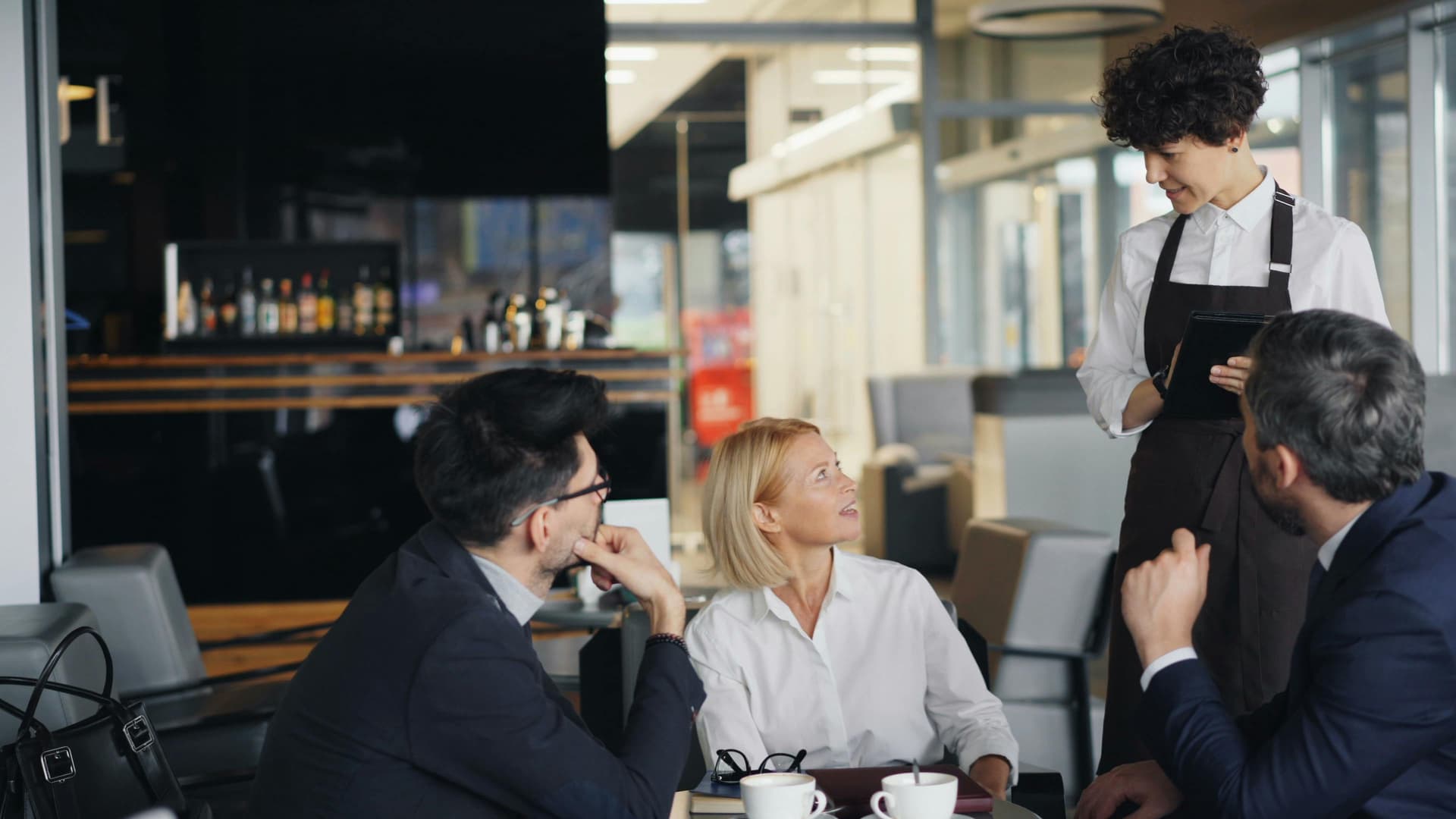
According to upselling experts at NowBookIt, the most effective upselling happens when servers lead from genuine knowledge and personal recommendation — not memorized lines. A server who says "The Malbec is unbelievable with the ribeye — I had it for staff meal last week" is not selling. They're guiding. Guests respond entirely differently to those two approaches.
Toast's research on server upselling reinforces this: the best servers upsell with discovery questions that reveal guest context — are they celebrating something? Do they have a time constraint? Are they big on red wine? That context lets them make suggestions that feel relevant and helpful rather than transactional.
Training your team to upsell effectively:
- Require all FOH staff to taste high-margin menu items — you can't sell what you haven't experienced
- Teach specificity over generality: "The truffle fries are ridiculous right now" beats "Would you like a side?"
- Train on timing: suggest drinks as guests settle, recommend dessert when entrée plates are being cleared — not mid-bite
- Create a server incentive program — leaderboards, bonuses, or recognition for top upsellers — that makes this a team sport, not a chore
- Role-play common objections so servers can respond naturally without losing momentum
NowBookIt's data shows that restaurants with structured upselling programs see overall revenue lifts of 10–15% consistently. The strategy isn't complicated. The execution is what separates operators who talk about upselling from those who bank on it.

3. Make Beverages Your Highest-Percentage Upsell
Beverages are the highest-margin items in almost every restaurant. Food cost on a craft cocktail or a premium glass of wine is typically in the range of 15–25%, compared to 28–35% on a plated entrée. Every beverage upsell is disproportionately profitable.
Yet most servers open the table with a flat "What can I get you to drink?" — a yes/no question that invites a water answer. That's a missed opportunity every single time.
Beverage upselling plays that actually work:
- Lead with specifics: "We just got a dry-hopped IPA from a local brewery that's been incredibly popular — can I grab you one to start?" beats an open-ended drink question every time
- Suggest pairings by entrée: Build a simple pairing guide for your kitchen team and FOH — beef + Malbec, salmon + Pinot Gris, spicy dishes + craft lager. Make it second nature
- Offer premium non-alcoholic options: According to restaurant industry trend data from Eat App, mocktail sales have surged by 350% year-over-year — this is a real revenue category, not a niche afterthought
- Suggest by occasion: Guests celebrating something? Offer a Champagne toast, a dessert cocktail, a shared bottle of wine for the table
On average, industry data compiled by Restroworks shows the average dine-in check in the US reached $54 in 2025, driven in large part by beverage additions and higher-margin item selection. Operators who actively build beverage culture into the guest experience are pulling that number significantly higher.
4. Automate Upselling With Your POS System
Here's the uncomfortable truth about human upselling: servers forget. During a dinner rush with a five-table section, a six-top birthday party, and a runner who called out sick, the dessert suggestion is the first thing that goes. Upselling consistency breaks down exactly when you need it most.
That's the gap that your POS system should be filling.
According to the National Restaurant Association, 60% of adults say they'd prefer to place orders on a tablet at the table, and 65% prefer to pay the same way. Tableside ordering technology doesn't just speed up service — it creates a consistent, always-on upselling moment that no human team can replicate at scale.
Modern restaurant POS platforms with AI capabilities can:
- Prompt add-ons automatically: When a guest selects a burger, the system suggests a premium protein upgrade, specialty sauce, or side before the order is confirmed
- Surface pairings in real time: Beverage recommendations tied to the specific entrée ordered
- Identify returning guests: Display past order preferences so servers can personalize service before the guest even opens their mouth
- Track upsell acceptance rates: Know which prompts are converting and which are being ignored — then optimize
According to AI upselling data from Loman, AI-driven upselling increases ticket sizes by 20–40% on average across digital and voice ordering channels. Critically, Loman's operational research shows that AI delivers upsell prompts with 88% consistency — compared to human staff who miss the upsell entirely under pressure.
HubPlate's Revenue Engine puts this capability directly into your operation: automated upselling prompts through the mobile tableside POS, powered by AI menu intelligence via Google Gemini, with every suggestion tied to your actual recipe costing data so you're always pushing the items that move your margins, not just your sales. Pair it with HubPlate's real-time analytics and you'll know exactly which upsell prompts are working and which need to be refined.

5. Turn Your Online Ordering Channel Into an Upsell Engine
If you're running third-party delivery, you're paying 15–30% commissions and your guests never see a single upsell prompt your team would normally make. That's margin leaving through two doors at once.
The fix is first-party online ordering — and it's where your upselling strategy can run completely on autopilot.
According to data from Restroworks, customers who order directly from a restaurant spend 35% more per transaction than those who order through third-party apps. Part of that is the absence of delivery fees making guests more generous, but a significant portion is the upsell architecture that's built into a properly configured first-party ordering system.
Online upselling tactics that drive results:
- Strategic item placement: Feature your highest-margin items at the top of categories and "above the fold" on mobile — Checkmate's digital upselling research confirms the first screen of your digital menu has an outsized impact on what guests order
- Smart cart suggestions: "Frequently ordered with..." prompts based on real purchase data — not generic suggestions, but actual behavioral pairings from your customer base
- Checkout add-ons: One-click additions (a dessert, a premium side, a drink) displayed at checkout are among the highest-converting upsell moments in the entire digital ordering journey
- Progress-to-minimum prompts: Show guests how close they are to free delivery or a loyalty reward threshold — this drives additional items added naturally
NowBookIt's research shows that restaurants actively promoting add-ons and upgrades through digital menus see average basket sizes jump by 19%, with online order values growing by 44% when upselling is built into the ordering flow rather than bolted on as an afterthought.
We covered the full strategy for eliminating third-party commissions and building a direct ordering channel in our Zero-Fee Online Ordering blog — the combination of commission-free delivery and optimized upsell architecture is how operators protect both their revenue and their margins at the same time.
6. Use Loyalty Data to Personalize Upsell Moments
The most powerful upsell is the one that doesn't feel like one. A server who says "You usually get the salmon — tonight we have it with a lemon caper butter that's incredible, and a glass of the Sancerre that pairs perfectly" isn't selling. They're demonstrating that they know the guest. And guests respond to that with open wallets.
The challenge is that this level of personalization used to require a server who had worked with a guest for years. Today, your CRM and loyalty data can deliver it to any staff member, for any guest, on any visit.
Research published by Olo on Restaurant Business Online found that 78% of diners now expect personalized promotions from restaurants they frequent.
Operators who are collecting first-party guest data and using it to drive upsell moments are turning that expectation into a revenue engine. The operator who can't — or won't — is leaving those guest dollars behind.
Loyalty-driven upselling in practice:
- Flag repeat guests and their past high-spend items in your POS so servers walk to the table informed
- Trigger automated offers through SMS or email based on order history — a guest who orders a steak every time they visit is a natural target for a wine club or premium add-on promotion
- Use loyalty tiers to incentivize higher-spend visits: "Spend $75 tonight and earn a free dessert on your next visit" is an upsell disguised as a reward
- Build "Chef's Table" or VIP experiences for your top spenders — personalization at the highest level creates loyalty and dramatically higher average checks
The full loyalty and CRM strategy is covered in our Restaurant Loyalty Program blog — the connection between personalization, repeat visits, and check size is direct and measurable once your data infrastructure is in place.
7. Time Every Upsell With Surgical Precision
The right suggestion at the wrong moment is worse than no suggestion at all. A server who pushes dessert while a guest is mid-entrée feels intrusive. A server who recommends a second bottle of wine after the check is dropped feels absurd. Timing isn't a soft skill — it's a technical discipline.
NowBookIt's upselling research identifies the key insight: guests are most receptive to upselling when they are already in the process of making a decision. That's the moment of highest permission — and it's where every upsell attempt should land.
A timing framework that works across every service style:
Moment Best Upsell
Guest settles in, before ordering Premium beverage suggestion
Guest orders entrees Appetizer / starter pairing
Appetizer delivered Wine or cocktail refill / second round
Entree delivered Acknowledge the dish, mention "perfect pairing" s sides if not ordered
Entrée plates cleared Dessert, after-dinner drink, coffee
Check presented Gift cards, loyalty enrollment
On the digital ordering side, the same timing logic applies — suggest add-ons during item selection, offer smart cart additions before checkout, and display loyalty program enrollment at payment.
A critical note on pacing: table turnover and upselling are not at odds — they work together when executed correctly. A guest who orders more courses on the front end (appetizers, drinks) typically has a higher-engagement visit and leaves more satisfied, which drives return rate. We broke down the full table turnover playbook in our How to Increase Restaurant Sales blog — upselling done right doesn't slow your service, it deepens your guest experience while growing your check.
The 2026 Upsell Opportunity Is Hiding in Plain Sight
According to McKinsey's 2026 Restaurant Industry Report, the defining challenge for operators this year is balancing affordability with margin protection. Traffic is down. Price increases are hitting their ceiling. The operators who survive — and thrive — in this environment are the ones who extract maximum revenue from every guest who walks through the door.
You don't need more covers. You need to make more from the ones you already have.
The seven strategies above don't require a capital investment or a staff overhaul. They require intention, training, the right technology, and a commitment to treating every table as the revenue opportunity it actually is. A 10% lift in average check size from $45 to $49.50 on 100 covers a day is $4,500 in additional weekly revenue — over $230,000 per year — from the exact same operation.
That's not a marketing projection. That's math.
Ready to Turn Every Order Into a Bigger Check?
HubPlate is built for operators who are done leaving money on the table.
The Revenue Engine delivers tableside mobile POS with automated upsell prompts built in. The Logistics Hub tracks your recipe costs so every suggestion your system makes pushes high-margin items — not just popular ones. The white-labeled online ordering with Uber Direct integration creates a first-party digital channel that upsells on autopilot, commission-free. And Google Gemini AI powers menu suggestions that learn what your guests love and serve them more of it, every single visit.
All of it runs on one flat rate: $99/month per location. Zero transaction fees. Zero commissions. BYOD — use the devices you already own.
No hidden costs. No revenue sharing. No hardware tax.
Book you demo at HubPlate.app →
ENJOYED THIS PIECE?
Share it with your network and help them scale too.